Showing posts with label slavery. Show all posts

Sunday, January 24, 2016

22: Myanmar - New horizons


So.  Myanmar.

I am not sure if I even know where to begin.  I feel as if I had the opportunity to watch a divine tapestry being woven.

On the first night of the trip we attended a grand opening of a multi-national church plant in Myanmar.  As part of the service, a lovely group of young women shared a dance they had learned together.  One of these young women shared through a translator that she did not deserve to be worshipping in that place, but that she celebrated the fact that Jesus had covered her sins.  She rejoiced that because He was worthy, and she was His, she was free.  I later found out that these women were all living and working together in the process of being restored from the trauma of being trafficked.

The term "trafficked"actually sounds too clinical to me, even though it is the correct term.  In the case of the women we met in Myanmar, being trafficked means being tricked, taken against their will, often times drugged and beaten, and even locked in a room, a shed, or chained to a bed until the captive demonstrated that she would be obedient.  This abuse can happen both in brothel communities and in cases in which young women are purchased as wives for men in China.  One shy and beautiful young woman we met walked with a limp from having her hip crushed in an escape attempt.

Later in the week, we visited the workshop where these young women heal and learn job and financial skills and adjust to a life with a regular routine.  The founder of the ministry, who engages regularly with workers in the red-light districts, explained that girls in Myanmar are lacking in the street smarts and awareness that could help them avoid being trafficked.  She told us that there is a dire need in Myanmar to provide awareness prevention tactics to pre-teen and teen girls who are most at risk.

Now, get this.

The remarkable woman who is investing her time, money and talent into reaching workers in the sex industry is a She is Safe partner in China.  She is also married to a man whom God has called to do humanitarian work with impoverished children in developing countries through mentorship and strategic partnerships.   He is currently serving as an advisor to an organization in Myanmar that is establishing programs for young children in the slums of Myanmar.  The programs seek to improve opportunities for children through education, relationship and training.


However, as they went around to the five different communities where they work, the leader of the program noticed something.  Although the program was intended for younger children, a surprising number of teenage girls were showing up each week, wanting to participate and interact.  In the process of working with younger children, the children's outreach staff was also building relationships with the teenagers, many of whom were no longer in school because of family relocation to the city or failure to pass exams.

Circumstances--poverty, innocence and halted education--put these teen girls at high risk for abuse and exploitation.   Fortunately, their circumstances also put them in relationship with people who knew the importance of awareness training and education.  The team began discussing the possibility of adding a program exclusively for teen girls in each of the communities where they worked.


Enter She is Safe.

Last May, She is Safe began exploring a partnership with the Myanmar organization to support their work with children and assist them in starting a program for teen girls.  Together they sought God's direction, set goals, and began raising funds to begin the teen program.

The trip I joined this December was a follow-up trip to the May meeting.  During our first meeting, my friend Katy introduced the concept of Transformation Groups, and what the ministry might look like in the context of Myanmar.  Her explanation generated great enthusiasm in our partners, as they could see the potential for impacting the communities where they are already engaged.

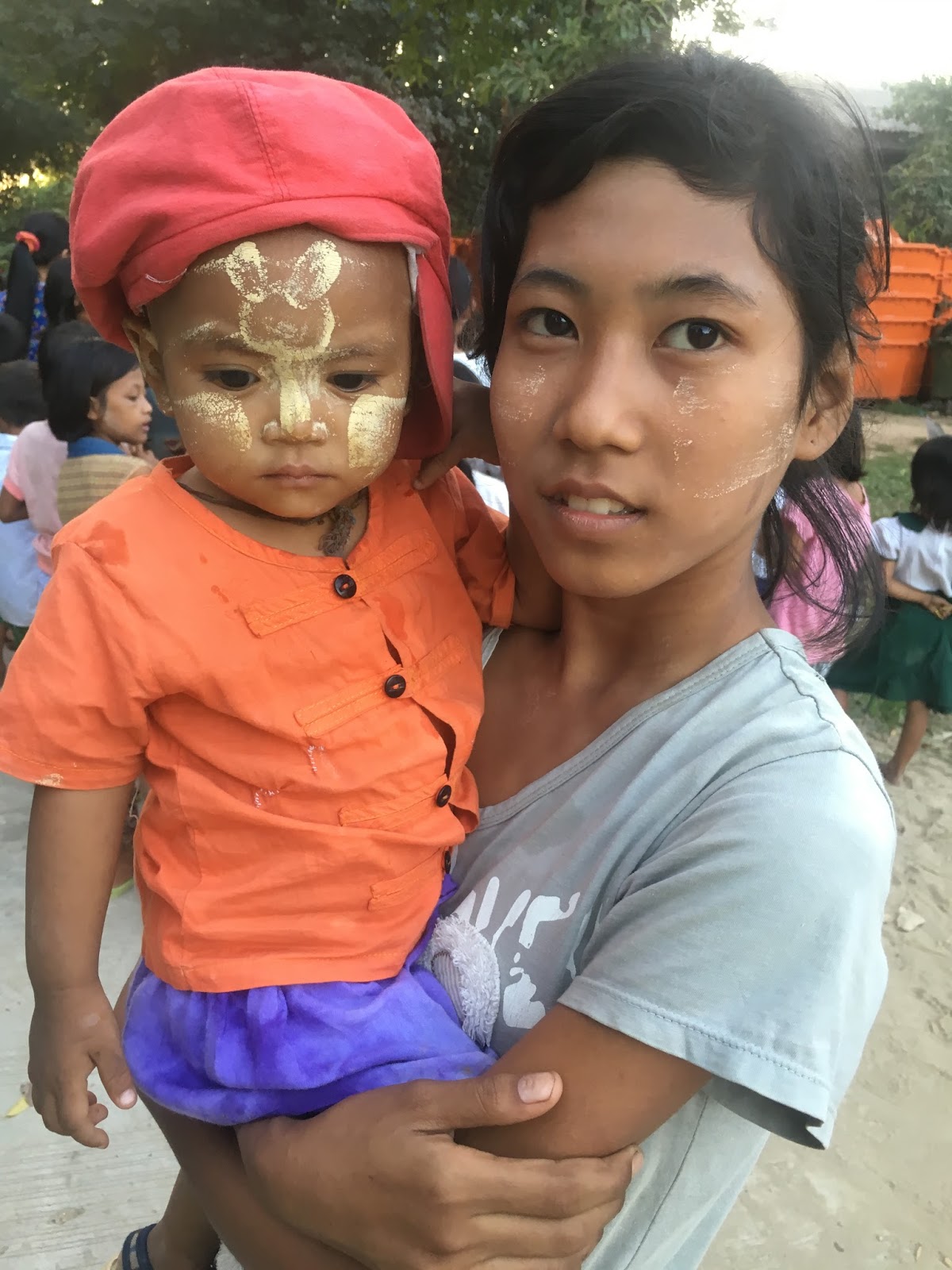
The next day we saw why.  As we accompanied the Myanmar workers on their rounds to the different communities, we noticed in a few of them that not only were teenagers coming to participate, the mothers returning from work often stopped to watch as well.


Right there, in those five communities, relationships are being built with children, teens and mothers. These relationships are critical, because the culture is intensely relational; nothing happens without first establishing relationship.  Because of the initial efforts of the She is Safe partner, these five communities are now ripe for  multi-pronged prevention efforts based on the relationships that have been nurtured over the past year.  With proper resources and staffing, She is Safe partners are poised to empower children with education and hope, equip teenage girls with preventive awareness and opportunities, and mothers with self-governing Transformation Groups that can enrich their communities on many levels.

She is Safe and their partners are ready to begin the work.  Are you ready to help?


Saturday, January 16, 2016

21: It Takes a Team


I mentioned before that upon learning about the extent of modern-day slavery (27 million slaves worldwide today) and human trafficking in the world, my gut-level response was a passion for rescuing slaves and those enduring the horrors of human trafficking.

Then I learned about the work She is Safe does training women in the work of Transformation Groups.  This work captured my attention because of the potential to attack the problem of human trafficking by empowering women to slowly and pervasively alter the oppressive aspects of their culture by benefitting their communities.  The change brought about through an effective Transformation Group could actually keep trafficking from happening in the first place.

Think about it--as exciting as it is to hear stories of women and girls being rescued from horrific situations, I can guarantee you that every one of them would say that it would have been even better if they had never been trafficked.

Looking back now, I can see that my enthusiasm for Transformation Groups and prevention work made me a little frustrated with what seemed like a focus on the work of rescue over prevention.

Here's the thing:  It all matters.

As we were preparing to travel to Myanmar, my friend Katy mentioned a video she had seen that painted a great picture of the comprehensive work of anti-trafficking.

This is not my word picture, but it was a powerful image for me in gaining understanding about the scope of anti-trafficking.

Imagine you are on the side of a river and notice there is a child in the water flailing about, drowning.   Of course, you must save that child!  The right thing to do at that moment is jump into the river, pull the child to safety, and begin working to revive him.

Even as you are attending to the gasping child, you notice another child coming downstream, in trouble and struggling to survive.  Again, you jump in.  This cycle repeats itself until it seems there is a never-ending crisis as child after child floats down river.

The sheer number of victims and relentlessness of the flow cause you to think: What is going on up river that all these children are drowning?  Do they not have boats?  Have they never learned to swim?  

It would be useful to run upstream and find out what is causing the crisis at hand, except that if you leave your spot to find out, the children currently in the river where you are would be lost.  You need to stay where you are, but someone needs to go find out what's going on upstream and work to solve the problem there.

What is needed is someone up river, identifying the sources of the problem and doing the work to prevent children from falling in.

Do you see?  BOTH locations are critical in stopping the crisis.

That is the idea in anti-trafficking work; it takes a team of workers, working together at different points in the trafficking process to solve the crisis.

Rescue IS important.  When I was in Myanmar, I met several women who had been rescued through a brothel outreach.  Many of them had previously been trafficked to China and escaped, only to begin working in the brothels of Myanmar because they believed the lie that they were ruined in China and that the sex-industry was now the only place they had value.  However, through the friendship of some rather remarkable people, these young women were able to realize that they were not damaged goods, and that there were options open to them besides prostitution.  In a shelter in Myanmar, they were healing their minds and spirits, and re-learning "normal life" things like keeping a routine, working predictable hours, and caring for themselves and their surroundings.  Seeing these lovely, shy faces, who were obviously healing and growing in confidence, I could never again say that prevention is more important than rescue.

Still, on my visit to Myanmar, my fervor for prevention work only deepened.  Not only did I meet young women who had been victims of human-trafficking, I also had the joy of meeting many children and teen girls who moved from rural areas with their families because the best jobs available to their parents were to collect trash in the city.  Because of life circumstances like poverty and lack of education, too many of them are at high risk for being trafficked.  Looking at the still innocent faces of the children and teens we visited and knowing the deep emotional and spiritual scars that result from trafficking, I am even more desperate that prevention work should be happening.

The beauty of the illustration of the river is the understanding it gives me of the work of She is Safe. They also grasp the idea that a team is needed.  They do not prioritize one branch of work over another.  Instead, they are like a person who assists the people working all along the river who cannot leave their posts.  They form partnerships in high-risk areas, providing assistance, resources, and encouragement to the leaders in the area who are already doing prevention, rescue and restoration.

In later posts I will write more about what this partnership approach looks like in Myanmar.   In the meantime, I encourage you to go to the She is Safe website and learn more about their partnerships and the countries where they are involved.


Thursday, December 24, 2015

Twenty: You Can't Cure a Disease by Treating Symptoms


I feel like I need to explain my statement in a previous post that God did not use me in Myanmar.  It doesn't mean that God had no purpose for sending me.  It's just that I suspect that the primary purpose for this trip was not so much for me to be used by God to save others, but rather for God to teach me.   I hope that in sharing what I've learned, however, the trip will have value beyond just my personal enrichment.

This trip felt like a bringing together of several strands of knowledge that I've been learning since a trip to Haiti in 2010, but the short version is this:  There is a right and a wrong way to engage internationally to foster justice and fight oppression, and She is Safe does it right.

I saw the results of "aid gone wrong" on a post-earthquake trip to Haiti.  Although I couldn't have put my finger on it at the time, I was troubled by a rather dependent mind-set on the part of many (but by no means all) Haitians whose answer to difficult times was to request money or rescue from their wealthier non-Haitian contacts.  In hindsight, I believe the attitude is one WE created over decades of well-intentioned but poorly designed efforts to help the struggling nation.

In their book Helping Without Hurting, Steve Corbett and Brian Fikkert suggest that "helping" can actually hurt the recipient because it too often fails to address the roots of the problem.  For example, many programs by churches and humanitarian organizations have the goal of poverty alleviation.  However, the programs have an incomplete and unbiblical view of poverty as a lack of material goods or financial opportunity.  In this view, the "solution" is too often simply to give the needy the material goods that are lacking.

In reality, this approach is merely treating a symptom of the much deeper and more complex psychological and social roots that lead to poverty.  As a result, our well-intentioned handouts have the unintended side effects of creating dependency, undermining the dignity of the materially poor, and perpetuating the underlying causes of poverty.

Corbett and Fikkert prescribe a more biblical and holistic view of poverty as "rooted in broken relationships with God, self, others, and the rest of creation."  Using the Bible as their guide, the authors propose modeling development efforts after God's mission of what they call "comprehensive reconciliation" in ways that restore not just material possessions, but opportunity, dignity, and an appreciation of one's identity as a divine image-bearer.

Applying the perspectives offered by Corbett and Fikkert to the important anti-trafficking work that is much more in the spotlight these days, I can see how I have made similar errors in thinking.  When I first learned of the extent of human-trafficking in the world--and particularly sex-trafficking--my response was what I hope most people's would be: "We have got to stop this!  We have to rescue the women and children enduring such horrors!"

It's not wrong thinking, but it is incomplete.  Yes, we must have programs that work directly to rescue people from slavery and exploitation.  However, until we address the underlying systems of thought and culture that foster the treatment of humans as property, until we attack thinking that elevates personal gratification over all else, trafficking will continue to flourish.

Such an approach is a daunting undertaking:  It is slow, complicated, messy, and definitely not for the faint of heart.   On my trip to Myanmar, I had the privilege of seeing such efforts walked out by She is Safe staff members and their partners in Myanmar.  Seeing all of my book-learning walked out in practice in a context that is so ripe with opportunity is why I can say with confidence that my trip was a success despite the fact that I rescued no one.


Sunday, August 23, 2015

Anything?


I think God might be messing with me.  Two days after writing in tears about my gradually emptying nest, I got a request from a friend to take a trip with her.  To Southeast Asia.

This summer a group of my friends, some just starting out and others, like me, with a bit more "experience," read a book together by Jennie Allen called Anything.  The book is an accounting of what led her and her husband to pray the prayer that she says unlocked her God and her soul.  The prayer was simply, "Anything, Lord.  I'm in."

It was interesting for our group to discuss, because the group was composed half of young women preparing to leave the nest, and half of women whose nests were emptying.  To a woman, we were all on the cusp of a monumental life transition.   All of us were asking, "what am I supposed to do with my life?"

"Anything" is a prayer we all would benefit from praying, but most fear, because telling God "anything" means He could ask....well, ANYTHING, and most of us are pretty comfortable.  As comfy North Americans we tend to think in self-preserving terms, fearing that if we surrender and say, "anything," God will ask us to give things up or do something really big.  Big as in sell-your-home-and-move-to-Africa big.

I honestly thought I was pretty down with the whole "Anything" concept.  I had just the year before gathered some activist runners and put on a virtual 5k to raise money for an organization I love called She is Safe, and was ramping up for the second annual.  Not huge, but out of my comfort zone.

It's a funny thing about stepping out of your comfort zone.  It often takes you even further out.

Like to Southeast Asia.

I have to confess, my first response was not, "ANYTHING, Lord!"

More like, "ARE YOU EVEN KIDDING ME RIGHT NOW?!"

You have to understand.  When I think of adventurous travel, I think Europe, or at least a country where I have an inkling of a chance at communicating--at least the same ALPHABET for heaven's sake. I mean, I went to Haiti during a cholera outbreak and political rioting, but at least they speak some French there.  And it's in the same general hemisphere.  My mental awareness of the globe sort of stops at France.

Also, this would involve flying over LOTS of open water--and I get panic attacks on a paddle board.

Truthfully, I have a plethora of really good reasons to say, "Not this trip."

Like justifying spending $2500 on myself--right before Christmas--when I've got two kids in college, every vehicle has 200,000 miles on it (and we don't do car payments), my students are sliding together down to the ends of our lopsided couches, and my sweet husband is working is tail off trying to make it all happen.

And speaking of my husband: His job takes him out of town half of every month.  We live on a farm, so going while he's gone means leaving the farm without a farmer, but going while he's home means giving up the precious little time I have with him.

Oh, and then there's that little section of the travel planning pamphlet that addresses their policy for hostage situations.  I'm reading about how they'll handle the unlikely event that I get taken hostage--and just the other day I was telling my daughter's friend about how I AVOID LEFT-HAND TURNS if possible because they are more dangerous.  What's wrong with this picture?

Still...every single objection I have can be summed up in this equation: Guilt + Fear = NO

But I have been pleading for over a year with people to please give a darn about the plight of women and girls in parts of the world where they are treated as commodities or burdens. This is a chance to go and see the beginning stages of the creation of a Transformation Group that could impact generations of communities in the areas we'll visit.

I'll have an opportunity in a tiny way to enter into the lives of women and children living in extreme poverty who earn money by separating out recyclables, and maybe, just maybe be able to communicate to them that in them I see dignity, value and the fingerprints of God.  It's a chance to see with my eyes, feel with my heart, touch with my hands, and then share with my words.

Plus, the fact that it seems so impossible makes it a just little irresistible.  What kind of God story might this be if God makes the impossible possible?

Here's the great thing about "Anything:" I am realizing (at least at this stage in the game), I don't have to say, "Absolutely" to this one thing just yet...I simply have to say, "As You wish," and surrender it to Him--come what may.

Will you pray for me?  I'll keep you posted.


Tuesday, December 3, 2013

Sex-traffickers, the Prophets and Jen Hatmaker


The past few weeks God has been creating a perfect storm that is MESSING. ME. UP.  I feel compelled to write, but I'm not even sure I can express clearly what is churning in me. I want to be polite, clear, and logical in challenging people, like the ever-gracious Tim Elmore, but my discontent is so deep right now that I think I'll probably slip more into a Matt Walsh-esque degree of snarkiness.

Except that, honestly, I don't feel snarky.  I feel desperate.

Here's the storm:

I have recently begun working to put on a 5k to raise money for She is Safe, an organization that works to fight human trafficking through prevention, rescue and restoration.  I've been interested in the issue for several years, but in recruiting helpers for my cause, I have been reading and re-reading stories of girls affected by human trafficking.  I am sickened by the number of cases in which it is actually a girl's family that sells her into slavery to be used up and abused as a commodity to satisfy the greed and perversion of oppressors.  What kind of parent would sell a child into prostitution?

At the same time, my chronological read-through of the Bible has landed me in Jeremiah (aka, the weeping prophet).  Turns out he was weeping because he was commanded to give God's message of judgement to a people who didn't want to hear it (Jeremiah 7:27). As He speaks through Jeremiah, God calls His people "adulterous" and accuses them of prostituting themselves to other gods.

Meanwhile, during my break from teaching, I am also finally reading the book 7:An Experimental Assault on Excess by Jen Hatmaker, which was recommended by a friend.  While reading the chapter on her drastic reduction of media consumption, the final "disturbance" collided with the previous two to produce a spiritual typhoon within me.  I don't know what it was specifically about that particular chapter (conviction, perhaps?), but suddenly the realization hit me full in the gut:

How can I be enraged by impoverished parents selling their daughters, when we here in the land of plenty are prostituting our own children to idols?  Because whether we realize it or not, I'm afraid we are.

For the past nine years I have worked in the youth ministry at our church.  For the past eight years I have taught writing classes to Middle School and High School students.  Every year for the past four years, the young people I've encountered have gotten markedly more self-absorbed, demanding and apathetic about the Gospel.  And I'm talking about the good kids.   This does not make me angry; it breaks my heart, because I LOVE these kids!

Sincere, godly parents bring their kids to church faithfully, send them to camp, VBS, and mission trips.  What they don't recognize is that their kids don't even see the spiritual feast laid before them because they can't take their gaze and attention away from their smart phones.  They have no interest in the Word of God because they are too busy broadcasting their own words and images into cyberspace and then compulsively checking their "approval ratings."  (I once listened to a group of 14- and 15-year-olds discuss their marketing strategies for getting Instagram followers.)

I've watched as teens receive praise and honor (heck, I've been one of the adults heaping praise) for worshipping at the altar of achievement, even when the pursuit of that success has become a source of identity, an idol, in the life of that student.  I've watched when that success leads to arrogance, pride and contempt for those less talented.

I've witnessed teens who obediently sit in church, passionless and bored, critiquing not the content of the message, but the entertainment value or delivery.  If it doesn't satisfy them, they feel they are absolved of the responsibility to listen--because the Word of God is no longer good enough on its own.  Yet I've seen these same seemingly passionless kids raising their hands in adoration for a boy band or football team. I know many girls who know exponentially more about the members of One Direction or Luke Bryant than they do about Jesus, and many boys who know more about their favorite athlete or video game than they do about their Savior.

More often than not, I leave my time spent with youth grieving for them and the emptiness that they don't even realize is their life.  I'm not blaming this entirely on the adults in their lives.  The culture that surrounds them certainly plays an overwhelming role, relentlessly bombarding them with lies and distractions.  I constantly thank God that I did not have to navigate my teen years during this generation.

But here is the conviction that is crushing me.  We tell our kids to follow Christ, but then we give them full access to every possible distraction that isn't blatantly evil.  We avoid boundaries because we fear stirring up a heart of rebellion.  Wanting to extend grace, we make excuses for "little"sins so often that I fear this generation doesn't see the need for a Savior, because they don't really think their sin is all that bad.

It's tempting to simply shrug these trends off and say, "Well, they're teenagers--it's a stage---they'll outgrow it."  We would be buying a lie.  According to Jen Hatmaker's research for 7, "94% of evangelical churches reported loss or no growth" last year.  She claims, "We are losing three million people annually, flooding out the back door and never returning."  The people flooding out are those who have been raised in church--those we thought were just going through a stage and would outgrow it.  Why do they leave?  Because they have found something else to worship.

Honestly, if I found out that one of my kids was battling an addiction to drugs, I would WAGE WAR on those drugs.  Why, then, do I buy into the notion that it's unreasonable to wage war on an addiction to an ipod, video game, cell phone or shopping?

My aim is not to point fingers or place blame, but simply to challenge us ALL to examine our role in the lives of our young people.

In my case, I know the first heart I need to examine is my own.  Do I have idols that pull me from Jesus?  Do I need to remove anything from my life that competes for first place?  Am I placing importance on any thing or behavior that is actually misplaced worship?  Am I making excuses for my own sins, rather than agreeing with God, being honest about them and repenting?  I want to start with myself because the best way to help the young people in my life is to set the example of honestly and humbly tearing down the idols in my own life.

Next, (and, I have to confess, this is MUCH harder for me), I need to put in place and enforce appropriate boundaries in the lives of those over whom I have authority.  This task is tough for me because I hate confrontation--and boundaries create confrontations.  Boundaries are not popular--and I want people to like me.  In many cases, the boundaries I need to set will be very countercultural. People will think I am weird--or worse--judgmental.  For a weak-willed, distractible people-pleaser like me, enforcing boundaries is a daunting task.

But God calls me to speak the truth, and the truth is this:  Anything that keeps a person from full surrender to Jesus is an idol, and we as parents, teachers, mentors, have an obligation to protect our young people from idolatry.   If not, we are prostituting them.


Tuesday, January 31, 2012

Because I am Free

I started this over two weeks ago.  This topic is so painful for me, so gut wrenching, that it has taken this long to finish.  I'm still not sure my words can do justice to the need....

As I am jotting items down on my list of 1000 gifts on January 11, I remember that it is Human Trafficking Awareness Day.  I must remember to wear bright orange.

I add to my list: daughters who have grown up safe, protected, and loved.

At the same time, I force myself to think---but what if.....

It doesn't require much imagination to consider, because I once had an unspeakable nightmare....

In the dream my youngest daughter, who is gentle, sweet-tempered and creative, is molested by a group of older boys.  I see it at a distance--almost as if from behind glass.  She is too afraid to cry out or fight, utterly bewildered, and panicked.  I can see her, but I can't get to her. I can't help her.  I am screaming, but she can't hear me.  She feels completely alone, and I have to watch her be carried away, helpless to rescue her.

I woke in a frenzy from that dream, adrenaline coursing so strongly I could have killed if the monsters from the dream had been within reach.

As much as I hate to think of dreams like that, I force myself to remember them today, because that nightmare is a reality for many women and children.

My daughters are safe, but not everyone's daughter is.

Some girls are taken.

Some parents are tricked by a promise of a good job in the city for their daughter.

Some daughters are actually sold by their parents, who know full well what awaits them.

All are trafficked, dehumanized, abused to satisfy the appetites of the depraved.

This should not be.

Slavery is NOT history; it is alive and well throughout the world... even in America.  Obviously, killing the bad guys is not the answer.  However, there ARE solutions, and many wonderful organizations working to fight this evil:

Loose Change to Loosen Chains
International Justice Mission
Somaly Mam
Love 146
One girl. One dress. One year.


Today, because I am free, I am speaking up for those who are not.

Translate